Can GTA 6 Make Its Missions as Free as Its Open World?
A different road out of a police chase sounds like a small freedom. In a story mission, it can be the difference between improvising an escape and following a sequence of instructions. Rockstar says GTA 6 is trying to bring those experiences closer together, while retaining control of important dramatic moments. Its developer interviews describe a selective opening of mission design, not the end of authored storytelling.
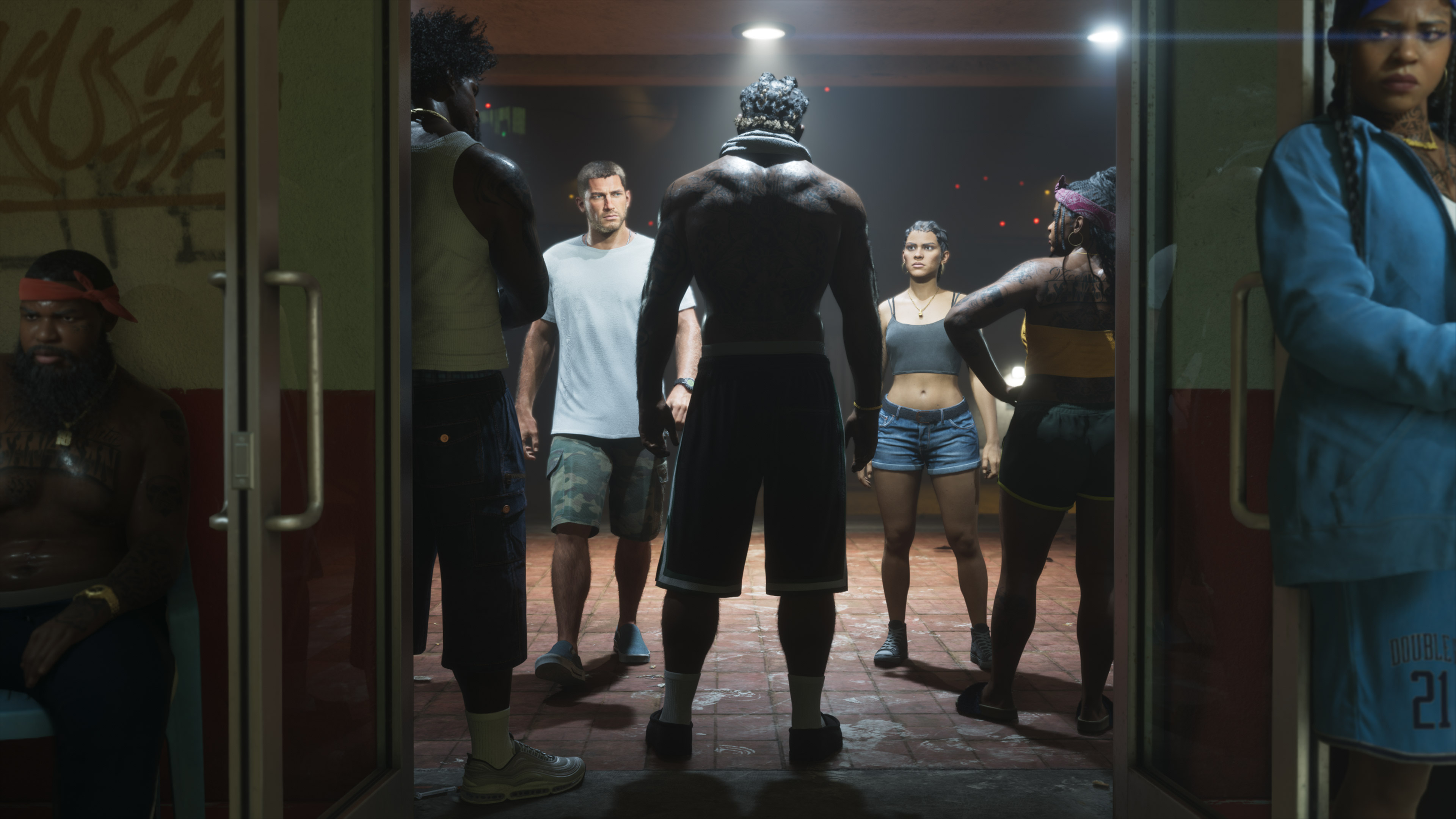
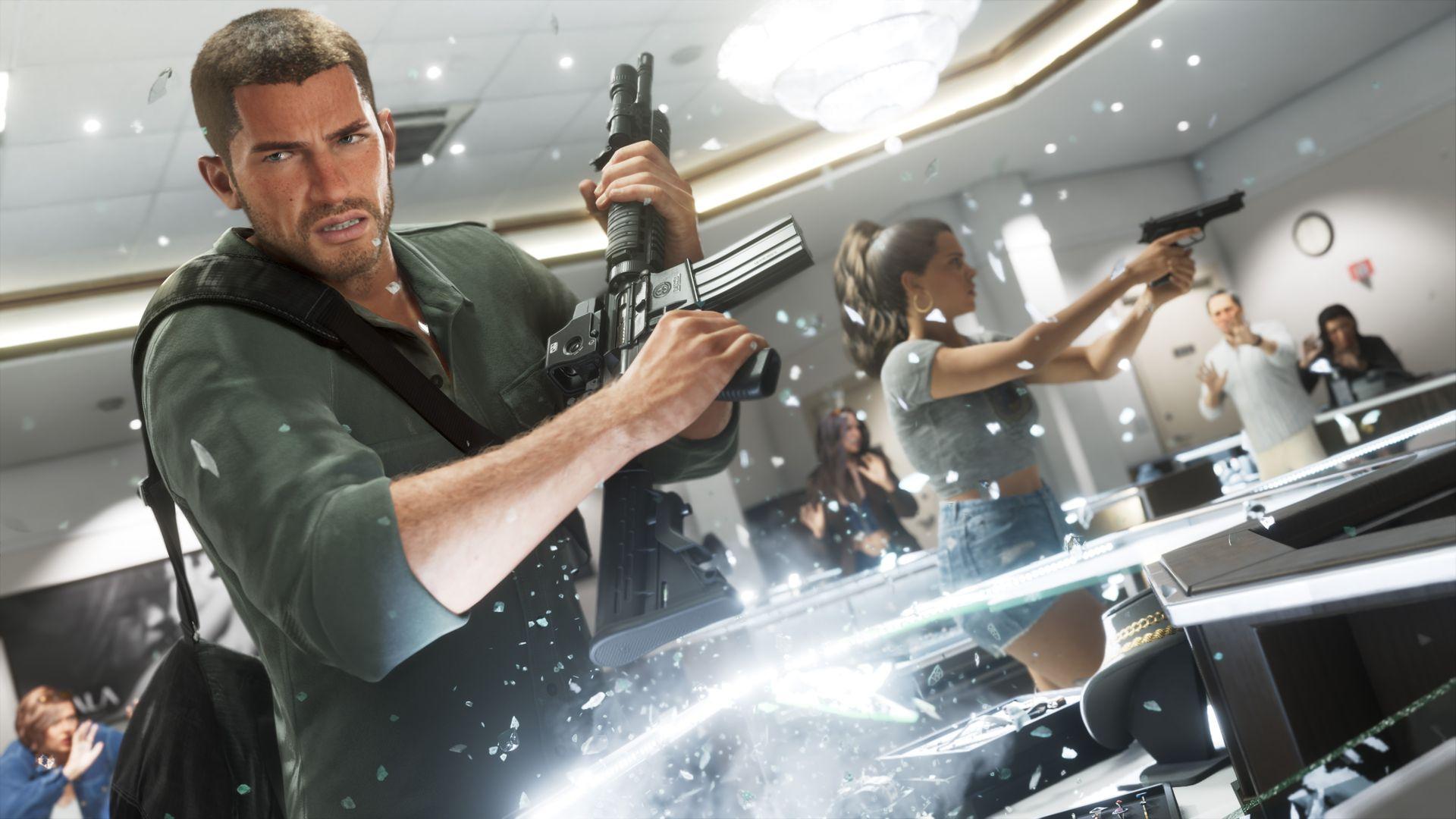
Official character imagery. This image does not establish which routes or character-switching options a mission permits. · View original source ↗
The important promise is consistency, not unlimited choice
In IGN’s full interview, Rob Nelson, Rockstar North’s head of development and co-studio head, describes a conscious effort to give players more room within missions when doing so does not damage the intended experience. His examples concern routes, pursuit and the relationship between scripted action and ordinary open-world systems. That is more specific, and more useful, than a blanket claim that GTA 6 lets players do anything. He also explicitly defends occasions when narrative has to take precedence.
Our reading is that the central issue is consistency. A player learns what a police pursuit allows while roaming freely, then expects that knowledge to remain useful when a story objective appears. If the same escape becomes invalid solely because a mission is active, the boundary between the two modes becomes conspicuous. Rockstar’s stated direction is to soften that boundary where appropriate. It has not promised that every mission will accept every method, or that failure conditions will disappear.
Sources: IGN: the full Rob Nelson interview
Two examples show different kinds of freedom
Nelson gives IGN the example of the tower-block sequence shown in the Extended Look: there are multiple routes out. That establishes a particular kind of choice, namely how to navigate an authored location. It does not tell us the number of exits, whether each route changes later events, or how widely the approach is used across the campaign. A building with several paths can still contain fixed encounters and a predetermined destination.
His second example is a car chase involving Raul. The opening is directed: the player controls Jason shooting while Lucia drives. Control then shifts to driving, and an advised escape route is not the only acceptable route. According to Nelson, the player can deviate and still get away because the mission becomes a police pursuit. Here, the flexibility comes less from selecting a doorway and more from allowing a familiar system to resolve the situation.
Sources: IGN: the full Rob Nelson interview
A mission can open its route while restricting its viewpoint
Famitsu’s interview supplies an important counterweight. Nelson explains that character switching can be restricted for story reasons, allowed freely in some missions or imposed automatically at particular moments. He describes the housing-complex sequence as a case in which the team chose to keep the player controlling Jason. The existence of several exits therefore should not be confused with freedom over every aspect of the same scene.
This distinction helps make sense of the design without declaring it contradictory. Spatial choice, control of the protagonist and control of the story are separate things. An author can insist that a particular character experiences an event while leaving the route through it open. Equally, switching between two playable characters does not necessarily create a branching plot. The interviews support a mixture of structures, rather than a universal rule that applies identically to every objective.
Sources: Famitsu: Rob Nelson interview · IGN: the full Rob Nelson interview
The open world is also being asked to carry the drama
Nelson’s ambition works in both directions. Alongside opening missions, he tells IGN that the team is trying to raise the quality of events that occur outside them. He recounts changing his plan during the demonstration after Jason suggested a job while they passed a location. He presents this as an emergent interruption of his intended journey, not a sequence that he had deliberately set out to demonstrate.
He also describes robberies and escapes in which the partner drives while the player deals with pursuers. When vehicle behaviour, the road and the pursuit line up, he says, the result can resemble a scripted set piece. These are examples supplied by a developer in a limited demonstration. They suggest a design ambition: make ordinary systems capable of producing dramatic moments, rather than reserving spectacle for story markers. Their frequency and reliability over a complete playthrough remain untested here.
Sources: IGN: the full Rob Nelson interview
Why Rockstar is not abandoning the script
Nelson is unusually direct about the trade-off. A particular narrative requires certain beats, and too much choice can make it difficult to sustain the quality the team wants. This is not a pledge to replace authored scenes with a simulation that writes the whole story. It is an explanation of why the studio may widen one part of a mission and tightly frame the next. The deliberate handover from shooting to driving is a useful illustration.
LOVE’s interview places that approach in a wider production context. Nelson describes laying out major story beats on the map and repeatedly evaluating the game through development milestones. His stated goal is immersion and connection to the characters, not realism as an absolute rule. In our analysis, the relevant question is whether restrictions serve a compelling moment and are legible to the player. A restriction can support a scene; an unexplained restriction can make the same scene feel arbitrary.
Sources: IGN: the full Rob Nelson interview · LOVE: GTA VI, The American Dream
What would actually demonstrate an improvement?
The most revealing eventual tests will be modest ones. Does a sensible alternate escape work? Does a pursuit follow recognisable rules after a mission begins? Does the game distinguish abandoning an objective from pursuing it through an unexpected route? Those are evaluation questions, not features Rockstar has confirmed. They would help measure practical freedom more effectively than counting map icons or treating the size of Leonida as proof of flexible mission design.
Companion behaviour will matter too. A route is only meaningfully available if the partner can keep up and the objective can continue. Likewise, an automatic switch can feel seamless or disruptive depending on its timing and communication. The interviews describe systems intended to work together, but do not provide comprehensive failure rules, checkpoint behaviour or a mission-by-mission breakdown. None of those gaps can be filled by assuming that a successful preview example represents the entire game.
Sources: IGN: the full Rob Nelson interview · Famitsu: Rob Nelson interview
A narrower promise worth taking seriously
There is a date distinction behind this analysis. Rachel Weber’s complete IGN transcript appeared on October 7, but she states that the visit and roughly 30-minute demonstration took place in July. Famitsu’s August interview and LOVE’s October publication add perspectives on Rockstar’s intentions; they are not three independent tests of a final retail build. GTA 6 Watch has not played the campaign, and this dossier does not assess its finished quality.
The supported conclusion is nevertheless substantial. Rockstar has identified the gap between authored missions and open-world improvisation, described particular changes intended to reduce it and acknowledged where it still wants control. Whether GTA 6 succeeds will depend on how naturally those boundaries operate across many hours. The promising idea is not that the script has vanished. It is that players may be able to contribute more of the action between its essential beats.
Sources: IGN: the full Rob Nelson interview · Famitsu: Rob Nelson interview · LOVE: GTA VI, The American Dream
The reporting behind this analysis
Famitsu publishes its developer interview
Rob Nelson discusses the duo, character switching and the connection between story and everyday play.
LOVE publishes its creative-team interview online
Rockstar discusses writing, world-building and its approach to connecting players with the characters.
IGN publishes its full July interview
The expanded transcript provides detailed examples and qualifications, not a new October playtest.
Continue reading
Related GTA 6 coverage
A GTA 6 developer spent two hours getting sidetracked without reaching a story mission
Bloomberg: Jason Schreier interviews Rockstar · 2026-10-14

Rockstar and Wynwood Walls bring GTA 6 art to Miami, with free entry for locals until 2028
Wynwood Walls: official partnership and local membership · 2026-10-13
Rockstar says GTA 6 will sacrifice realism when simulation becomes tedious
Numerama · 2026-10-06
GTA 6 ties some mission access to Jason and Lucia’s current income
Game Informer: direct Rockstar cover story · 2026-09-30

GTA 6 weather will bring localized rain, persistent puddles and hurricanes to Leonida
Game Informer: direct Rockstar interviews · 2026-09-29

GTA 6 driving aims for GTA 4's weight with GTA 5's accessibility, Rob Nelson reportedly says
TGG · 2026-09-21