Writing Leonida: The Voices That Make GTA 6 Feel Like a City
A city does not tell its story only through the people whose names appear in the plot. It also speaks through arguments on the pavement, advertising, political slogans and conversations overheard on the way somewhere else. Rockstar’s interviews reveal dedicated writing teams behind that texture in GTA 6. The ambition is not simply to put more people in Leonida, but to give the place a recognisable voice.
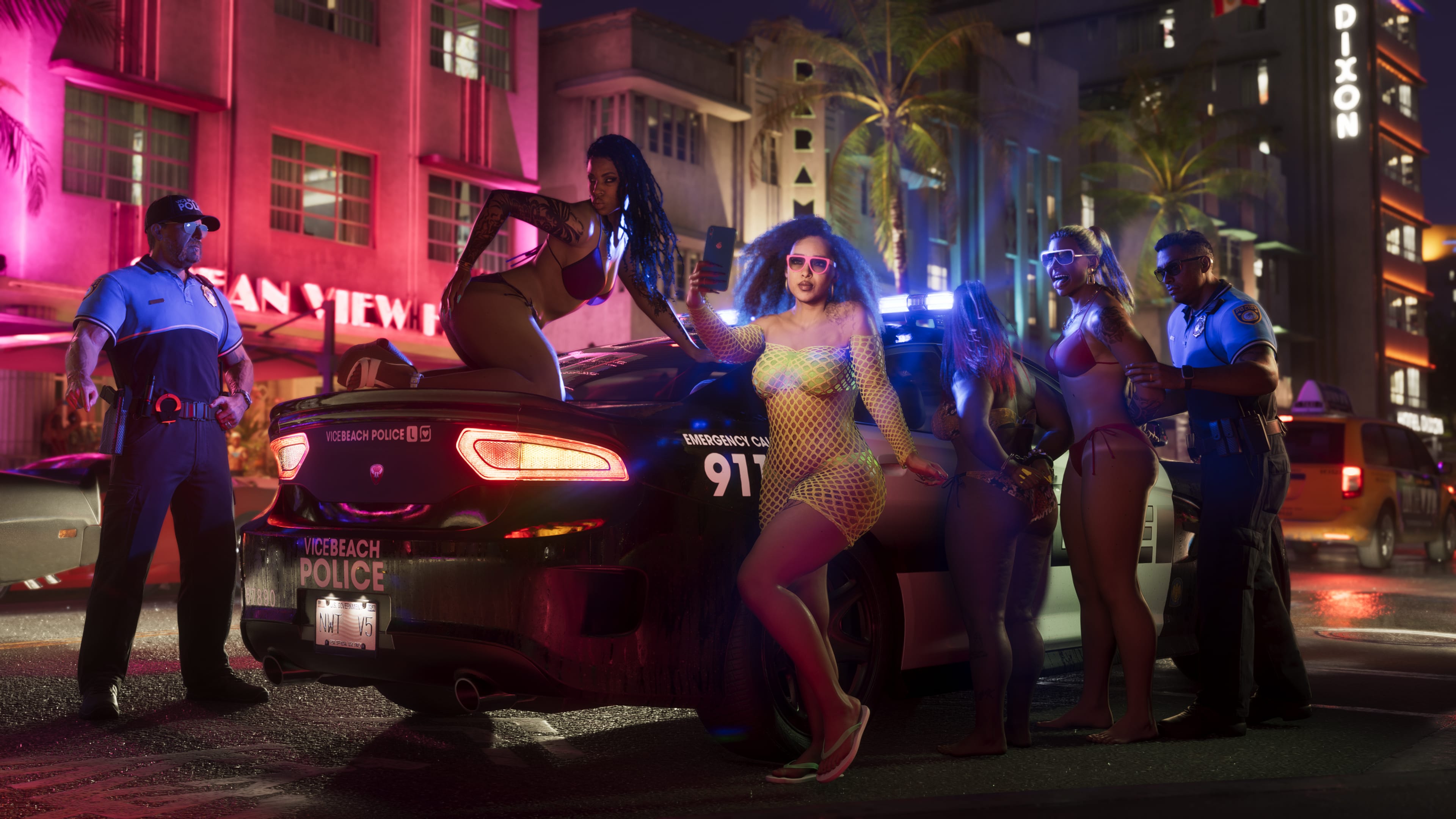
Official imagery illustrates Leonida’s heightened social world. A still image cannot demonstrate conversation systems or the frequency of unscripted encounters. · View original source ↗
The main story is only one way a place speaks
In LOVE’s interview, senior vice president of narrative Rupert Humphries rejects the idea that pedestrian dialogue and advertising are merely background. He describes a dedicated pedestrian-writing team in Los Angeles and advertising and comedy writers working across New York, Los Angeles and London. These are identifiable production roles, not an assumption that a dense crowd automatically generates interesting stories. The material is being treated as part of the experience of inhabiting the world.
That matters because players encounter a city out of order. A radio commercial may precede the business it advertises; a passing remark can colour a neighbourhood before a mission gives it a formal introduction. This is our interpretation of the function such writing can serve, not a claim about a particular undisclosed sequence. Unlike a cutscene, ambient material has to communicate something even when the player catches only a fragment and continues driving.
Sources: LOVE: GTA VI, The American Dream
Writing an overheard conversation is a different problem
Rob Nelson’s IGN interview approaches the subject from observation. He describes studying the rhythm of conversations encountered in real life and noticing how only a few words can convey their subject. Recreating that impression required coordination across writing, direction, production, animation, design and code. His account includes building a new team in Los Angeles to support the variety of dialogue. LOVE’s description of specialised writers supplies a complementary view of that work, not a count of the final script.
The craft problem is compression. An incidental exchange cannot always rely on an introduction, an attentive audience or a neatly timed ending. It must suggest people with concerns of their own while remaining intelligible through a brief encounter. That is different from making every passer-by explain the plot. It also helps explain why the number of lines alone would be a poor measure of success: placement, delivery and the moment at which the player hears them all affect whether a line feels alive.
Sources: IGN: the full Rob Nelson interview · LOVE: GTA VI, The American Dream
A conversation has to respond to being overheard
Nelson tells IGN that players can listen to NPC conversations, but that standing too close or following people can provoke a response. Someone may acknowledge the player, become aggressive or want to leave. He presents this as an evolution of the interaction work in Red Dead Redemption 2, applied to a more densely populated contemporary setting. These are developer-described behaviours, not a promise that every resident has the same awareness or that every conversation supports unlimited intervention.
Our analysis is that the reaction matters as much as the initial line. A convincing exchange can lose credibility if its participants ignore the person pressing against them to listen. Conversely, a response establishes that the player occupies the same social space as the speakers. Writing supplies the words, but distance, timing, movement and animation have to make those words appropriate. This is why the system cannot be evaluated as a screenplay detached from the rest of the game.
Sources: IGN: the full Rob Nelson interview
Advertising makes the satire part of the surroundings
LOVE asks Humphries about political imagery in Ambrosia and the relationship between satire and real-world commentary. His answer lists several ways political stories can reach the player without a face-to-face encounter: campaign signs, robocalls, radio commercials and talk shows. The significance lies in the different channels, rather than a new promise about a particular quest. Leonida can express the priorities and contradictions of its institutions while the player is busy doing something else.
An advertisement is especially useful for that purpose because it exposes what a fictional organisation wants people to believe. A slogan can establish aspiration, insecurity or hypocrisy without a narrator stepping in to explain it. That is an editorial reading of the tools Humphries describes. It does not confirm that every advertised product is usable, every business can be entered or every political message leads to an interactive storyline. World-building and functional availability are different claims.
Sources: LOVE: GTA VI, The American Dream
A long production cannot simply chase the latest meme
Humphries explicitly connects writing choices with development time. Material created across many years still has to feel relevant when the game reaches players. He describes resisting the temptation to chase a trend simply because it is briefly popular, instead drawing on broader phenomena such as conspiracy thinking and public reactions to everyday events. Rockstar’s stated method is to invent heightened equivalents rather than reproduce each real event or personality one for one.
That makes the satirical target less dependent on recognition of a specific headline. A player can recognise a pattern of behaviour without knowing which contemporary incident might have suggested it to a writer. Whether the jokes remain sharp is a judgement for the finished work; the interview cannot establish that in advance. It does, however, explain why identifying a resemblance in a trailer is not sufficient evidence that a character represents a named real person or that a scene recreates a particular incident.
Sources: LOVE: GTA VI, The American Dream
One exaggerated world, many different voices
Humphries says characters across different levels of wealth should belong to the same tonal world and share recognisable human weaknesses. He also describes a team with different backgrounds but a common comic sensibility. The goal is coherence, not identical speech. A political advertisement, a street argument and a central character’s vulnerable moment can sound different while still belonging to the same fictional place. That balance is more demanding than simply adding a joke to every interaction.
Famitsu’s reporter offers an observer’s perspective, describing the mixture of shop music, conversations, horns and sirens in the demonstration. It is evidence of what that journalist noticed during a limited visit, not our own sound test or proof of the finished mix. Read alongside the production accounts, it points to another challenge: writing must coexist with the rest of the city’s noise. More dialogue is not automatically better if important or interesting material becomes impossible to hear.
Sources: LOVE: GTA VI, The American Dream · Famitsu: Rob Nelson interview
Judge the texture over time, not by a script-size headline
The questions worth carrying into a full playthrough concern variation and context. How soon do familiar conversations recur? Do responses fit the player’s behaviour? Can incidental jokes surprise without drowning out emotional scenes? These are critical questions arising from the stated ambition, not additional features we are claiming Rockstar has announced. Neither an official screenshot nor a short developer demonstration can establish how a city sounds after dozens of hours.
The sources describe human writing teams and coordination with technical systems. They do not establish an infinite dialogue engine, unrestricted conversations with every resident or a generative-AI system, and this dossier makes none of those claims. What they do reveal is a substantial creative undertaking beyond the main screenplay. Leonida’s population is not only a rendering problem. If the writing and its delivery work together, a line overheard on the way to a mission could make the place memorable without ever becoming a mission itself.
Sources: IGN: the full Rob Nelson interview · LOVE: GTA VI, The American Dream · Famitsu: Rob Nelson interview
The reporting behind this analysis
Famitsu publishes its developer interview
Rob Nelson discusses the duo, character switching and the connection between story and everyday play.
LOVE publishes its creative-team interview online
Rockstar discusses writing, world-building and its approach to connecting players with the characters.
IGN publishes its full July interview
The expanded transcript provides detailed examples and qualifications, not a new October playtest.