From Vice City to GTA 6: The Same American Dream, a Different City
Returning to Vice City does not mean returning to the same game. Rockstar’s original product description sells an ascent through an extravagant 1980s city; GTA 6 introduces a couple caught in a conspiracy across Leonida. The shared name connects two fantasies of Florida, but the narrative perspective, cultural references and available technology have changed. This is a comparison of those choices, not a claim that old streets, missions or characters will return unchanged.

A familiar name now introduces a contemporary destination; the sign alone says nothing about continuity with the earlier map. · View original source ↗
Two pitches for an American dream
Rockstar’s Vice City product page describes big hair, pastel suits, excess and one man’s rise to the top of the criminal pile. It presents the city as a place to take over. GTA 6’s synopsis starts differently: an easy score goes wrong and Jason and Lucia must rely on one another while a conspiracy stretches across Leonida. Both premises concern crime and ambition, but the initial relationship to power is different.
Analysis: the earlier pitch invites the player to imagine mastery, while the newer pitch foregrounds dependence and vulnerability. That is a comparison of public framing, not knowledge of GTA 6’s ending. The couple may acquire power, lose it or redefine their goals. Until the complete story is available, promotional language is evidence of how Rockstar wants to introduce the game, not a substitute for its narrative.
Sources: Rockstar — Grand Theft Auto: Vice City · Rockstar — GTA VI
A visual comparison, not a matched-location test
The historical official screenshot below places a car on a broad, palm-lined road beside a beachfront promenade. The GTA 6 image uses an aircraft and the illuminated Vice City sign to sell arrival and scale. Both make movement through a desirable coastal destination part of the fantasy. They do not depict the same viewpoint, and comparing them cannot measure frame rate, world size or a change in street geometry.
That limit makes the comparison more revealing rather than less. Publicity images are selected compositions: one puts the viewer behind a vehicle, the other looks upward at an emblem of the city. The shared vocabulary of transport, palms and leisure survives, while the way the place is staged changes. Technical progress is visible, but it is not the only story these images tell.
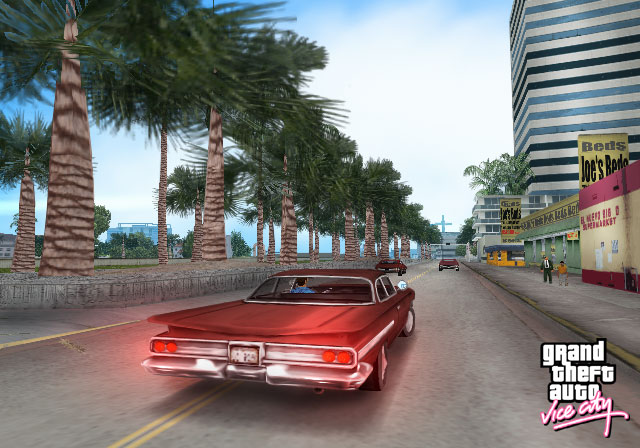
Earlier Vice City: broad roads, palms and a beachfront promenade. This is a historical publicity image, not a matched-location benchmark. · View original source ↗
GTA 6: arrival and spectacle. A thematic comparison, not the same street rebuilt. · View original source ↗
Sources: Rockstar — Grand Theft Auto: Vice City · Rockstar — official screenshots
From a postcard to a set of overlapping communities
Rockstar’s current Vice City description names Ocean Beach, Little Cuba, a flea market and the cruise port. Those locations suggest different kinds of work, aspiration and public space. Dazed’s interviews add a research team in Miami and conversations with residents from several social worlds. The official material therefore gives us more to discuss than whether the hotels are still pink or the clubs still glow with neon.
This does not mean the older game lacked variety, or that the newer one has automatically achieved a more sensitive portrayal. It changes the standard against which the work can be judged. A recognisable skyline establishes a setting quickly; differences in language, dress, movement and daily activity can sustain it over many hours. The final game will have to demonstrate that its communities amount to more than a longer list of stereotypes.
Sources: Rockstar — Only in Leonida · Dazed — interviews with Rockstar
The soundtrack is memory, but memory is not a station list
GamesRadar’s Extended Look analysis explicitly reads some music and vehicle details through affection for the earlier Vice City games. Its author discusses an older Sentinel convertible and an audible Phil Collins track as resonant callbacks. Those are attributed observations about promotional footage. They can support a discussion of nostalgia without establishing a complete radio playlist or the return of a named station.
The distinction is useful because nostalgia operates through recognition. A sound, a vehicle shape or a colour palette can evoke an earlier game even when the current scene has a different purpose. Players do not need an exact reproduction to feel the connection. Equally, a familiar musical cue does not establish a shared character history, a remake of a mission or permanent licensing in the released game.
The machinery of fame has changed
Dazed describes working in-game social feeds and discusses Real Dimez as artists whose rise is connected to viral posts. Rockstar’s official biographies similarly emphasise music, online presence and the desire for a hit. That gives the contemporary setting a different mechanism for public identity: characters can perform versions of themselves for an audience inside the fiction, not only for people standing nearby.
Our reading is that the target of the satire has shifted alongside the medium through which status is displayed. The older product pitch stresses visible excess; GTA 6’s documented character world also includes the circulation of that image. This does not prove a player-run influencer business or a system measuring the popularity of every action. It establishes cultural material for the story and a subject for analysis, not an unannounced career mode.
Sources: Dazed — interviews with Rockstar · Rockstar — Only in Leonida
A couple changes the perspective on freedom
Dazed attributes to Rupert Humphries a Bonnie-and-Clyde-style framing and describes switching between the protagonists in a shared journey. Rob Nelson discusses maintaining the essence of the characters while permitting player expression. These statements suggest that freedom is being negotiated through two established people and their relationship, rather than offered through blank avatars with no narrative commitments.
That could change how familiar GTA activities feel. An escape, a quiet drive or a visit to a club can be both an action in the world and a moment between the leads. The possibility is more specific than saying the game is simply more mature. Whether the relationship deepens ordinary play, limits it or does both will depend on writing and implementation we cannot fully evaluate from interviews.
Sources: Dazed — interviews with Rockstar
What the return to Vice City does not promise
A reused place name is not proof that a particular mansion, business, radio host or protagonist must reappear. Nor should a visual callback be treated as a direct story connection. The official materials used here establish a new cast, a broader Leonida setting and deliberate cultural echoes. They do not provide a complete continuity guide reconciling every earlier version of the city.
The most useful way to approach the return is therefore with two questions. What does Rockstar preserve because it makes Vice City recognisable, and what does it change because contemporary Florida and the story demand something else? That approach leaves room for nostalgia without making the new game answerable to a fan-made checklist of returning assets. A city can feel familiar while offering a genuinely different point of view.
| Theme | Earlier official framing | GTA 6 evidence |
|---|---|---|
| Ambition | One man’s criminal ascent | A couple caught in a wider conspiracy |
| Place | An extravagant 1980s city | Contemporary Vice City and wider Leonida |
| Status | Excess, glamour and taking control | Music careers, fashion and viral visibility |
| Nostalgia | The original game as reference | Callbacks reported in promotional footage |
Sources: Rockstar — Grand Theft Auto: Vice City · Rockstar — Only in Leonida · Dazed — interviews with Rockstar
Evidence timeline
The earlier Vice City enters the series
The original game frames a fictional 1980s criminal ascent.
Contemporary footage prompts comparisons
GamesRadar identifies familiar vehicles, music and brands in its Extended Look analysis.
Interviews explain the new cultural approach
Dazed documents a researched contemporary setting and a relationship-led narrative.
Continue reading
Related GTA 6 coverage
Game Informer reveals GTA 6 cover story with 12 new screenshots and Rockstar interviews
Game Informer · 2026-09-25
GTA 6 map leak: Rockstar removed four Leonida labels from a collection image
Rockstar Store · 2026-09-24
Rockstar confirms GTA 6’s $399.99 Vice City Collection — 11 collectibles, but no game
Rockstar Games Newswire · 2026-09-24
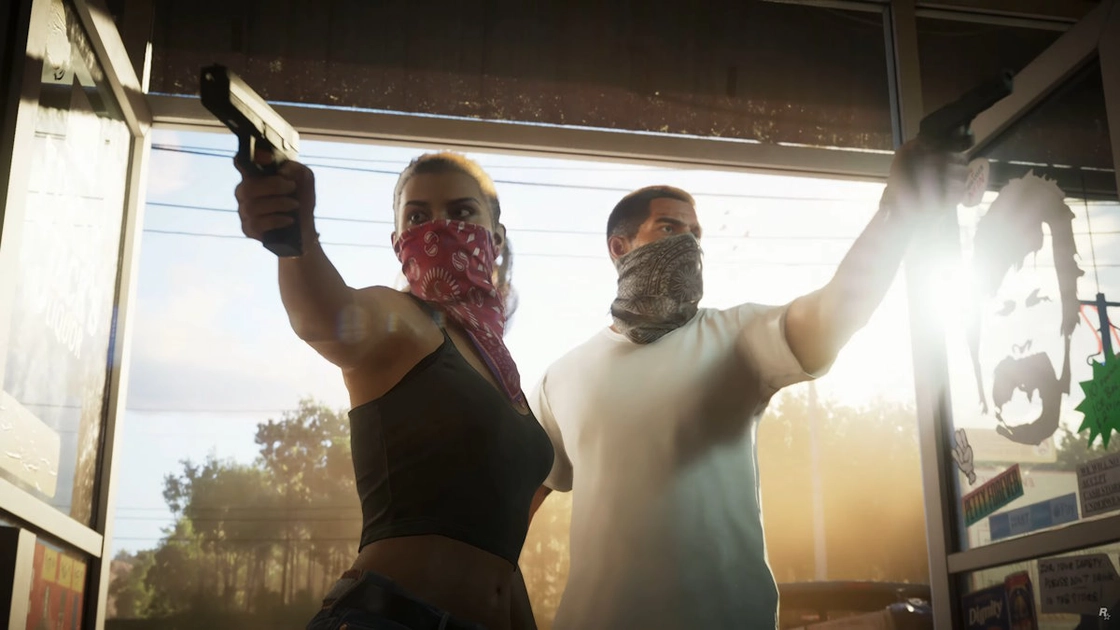
GTA 6’s ‘Welcome to Vice City’ sign is now installed on Miami’s Kaseya Center
WPLG Local 10 · 2026-09-18
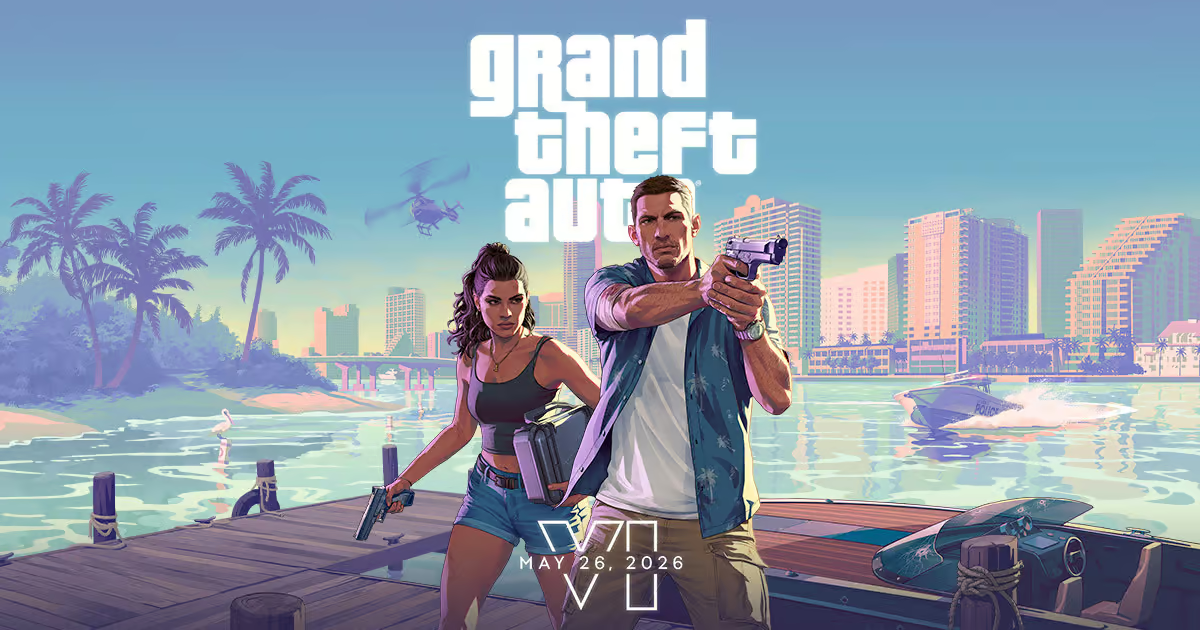
Stephen Root confirms GTA 6 role; Brian Heder identification reported
Associated Press · 2026-09-14
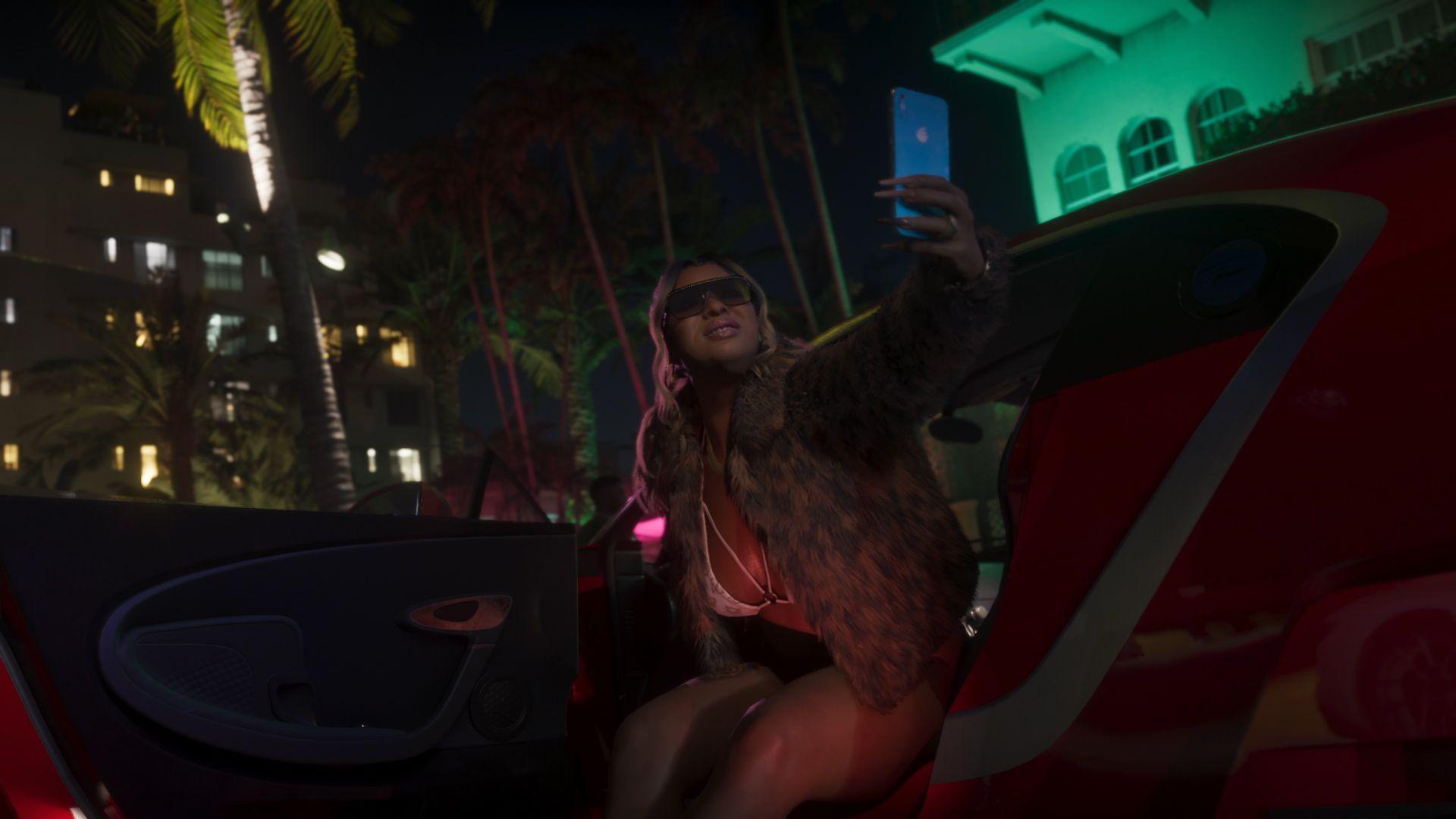
GTA 6 collector’s edition rumor now looks more like a press kit — what the new photos show
GTA BOOM · 2026-09-09