GTA 6 Police and Consequences: Beyond the Wanted Stars
The most interesting question about GTA 6’s police is not how many cars join a chase. It is what the police know, how they learned it and what remains after the chase ends. TGG’s August 29 preview account describes separate identification clues and persistent heat, while Dazed’s developer interviews establish a broader ambition for a more reactive world. Together they support a substantial analysis — but not a tested guide to the final game.

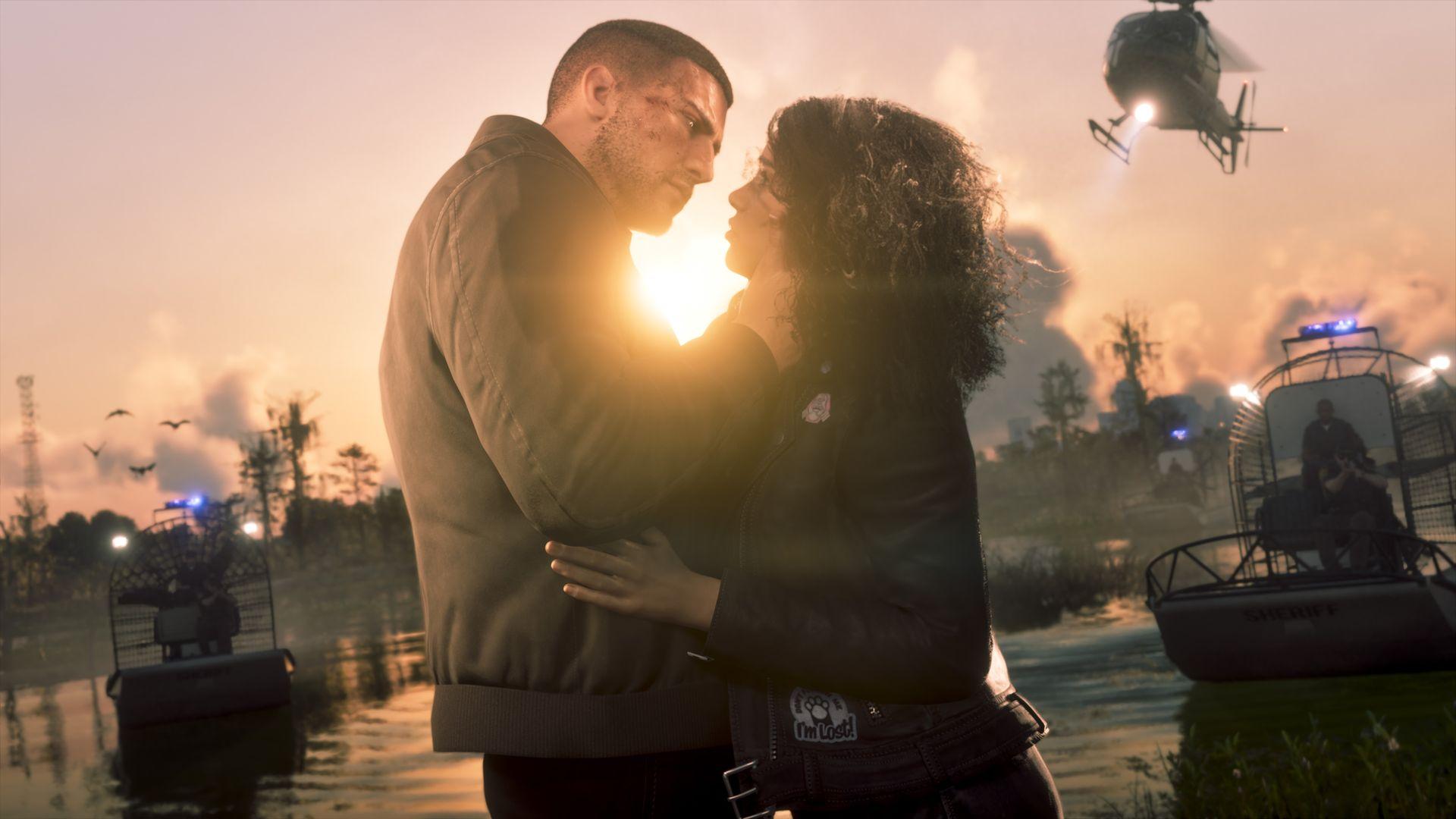
Official character imagery, not evidence of a particular wanted-state mechanic. · View original source ↗
One headline hides three different systems
A wanted level can represent the intensity of the response, a detection state can tell us whether police can currently see the player, and an identification record can preserve clues after visual contact is broken. These are different design problems. TGG says GTA 6 distinguishes them more explicitly than previous entries, using wanted stars together with indicators and areas of heat. We use that account as attributed reporting, not as a published Rockstar specification.
Dazed independently supports the broad creative direction: its feature describes a world reacting to a character carrying a rifle and quotes developers discussing immersion and iterative design. It does not independently verify every icon or rule in TGG’s explanation. Two sources discussing a reactive world are not automatically two confirmations of a particular pursuit mechanic. Keeping those levels separate lets us explain the idea without overstating its certainty.
Sources: TGG — police deep dive · Dazed — interviews with Rockstar
First comes the report, not necessarily identification
At roughly 3:11 in his video, TGG attributes to Rob Nelson a system in which a crime must be reported, with phone calls, alarms and tracked vehicles among the routes he describes. Later, he interprets a bank sequence as police knowing something happened without yet knowing whom to pursue. The important distinction is between awareness of an incident and a reliable description of its participants.
If the reported rules hold in the final game, that separation could make an encounter depend on circumstances rather than simply on crossing a trigger. But it does not establish that every isolated offence is undetectable, that all witnesses behave identically, or that players can predict a fixed response delay. Scripted missions, alarms and other constraints could produce exceptions. The source does not supply an exhaustive decision tree.
Sources: TGG — police deep dive
The clues that could survive an escape
From around 1:47, TGG describes indicators associated with CCTV, the protagonists being recognised together, outfits, appearance, weapons and vehicles. He explains them as signals of what the police have learned. In this account, getting out of sight and removing a known identifier are related but separate actions. Leaving a search area would not necessarily erase every piece of information already associated with the player.
The design implication is analytical: a pursuit could become a problem of managing information as well as driving skill. There is no verified final duration for that memory, no published universal reset cost and no independently tested rule for how multiple clues combine. We therefore avoid promises that one outfit change always clears a search or that a recognisable vehicle is the only thing police can use.
Sources: TGG — police deep dive
A robbery, reconstructed from the preview account
At approximately 8:09, TGG recounts a store demonstration and reads what he says was Nelson’s running commentary. The sequence involves a safe whose code is not immediately known, camera footage, an incident being called in and a decision to leave rather than continue searching. This is a valuable example precisely because it includes an abandoned attempt instead of a flawless promotional success. We did not witness that session ourselves.
The sequence below is a reading aid for that reported demonstration, not a walkthrough promising the same result. Each stage changes the trade-off: more time inside may mean more opportunity to find loot, but also more exposure to a response. Choosing to stop can become part of the encounter rather than a failure to consume all its content. That is the specific design possibility the account illustrates.
| Stage | What TGG recounts | Why it matters |
|---|---|---|
| Enter | A store with a safe and surveillance | Preparation does not guarantee access to all loot |
| Search | The safe combination is not known | Time becomes part of the risk |
| Response | The incident is called in | Potential profit competes with escape |
| Leave | The demonstrator cuts the attempt short | A partial result can still be a player decision |
| Afterwards | Police establish a perimeter | The location may remain consequential |
Sources: TGG — police deep dive
Heat is not the same as an active chase
In the section beginning around 5:18, TGG describes red stars and a neighbourhood-sized heat area after direct pursuit has ended. His interpretation is that police lack an exact position but can recognise the protagonists if remaining clues match. He also reports that the scale of a search varies with the wanted level. These are useful descriptions of the preview build, not verified bounds for the release version.
For players, the attraction would be continuity: a robbery could affect a return trip through the same area rather than disappearing the moment a timer expires. The risk is friction. A system that remembers too much for too long could make ordinary travel tiresome. Only hands-on testing can judge whether the feedback is readable, whether the penalties feel proportionate and whether quieter routes remain interesting.
Sources: TGG — police deep dive
Civilian reactions begin before the shooting
TGG’s account from roughly 10:44 distinguishes a long gun carried on the body, held in the hand or presented as if ready to fire. He recalls pedestrians moving away and attributes to Nelson a discussion of warnings and escalation. Dazed’s separate account also highlights public reactions to carrying a rifle. The common theme is a range of responses rather than a binary switch between total indifference and panic.
This matters because a believable city needs reactions that fit the situation. A crowd can look sophisticated in a cinematic yet feel repetitive if every person flees in the same direction during play. Conversely, small readable changes in posture can communicate danger without adding another interface meter. These are criteria for evaluating the design; they are not claims that every civilian has an individual memory or a complete daily simulation.
Sources: TGG — police deep dive · Dazed — interviews with Rockstar
What remains a claim, and what will need testing
The public transcript lets readers locate TGG’s statements and distinguish his recollection from our interpretation. It does not turn his quoted conversations into a Rockstar-authored manual. Exact colour meanings, search sizes, maximum response behaviour, mission exceptions and persistence across saves should remain provisional until documented or tested. Story-mode previews also do not establish how a future online service would handle any of these systems.
The sensible takeaway is not that Rockstar has already delivered the smartest police in games. It is that the reported design asks a richer question than whether the player has escaped a cone on a minimap: what evidence remains? If the final game makes that question clear and gives players meaningful choices, the pursuit can become part of the crime story rather than an isolated obstacle between missions.
Sources: TGG — police deep dive · Dazed — interviews with Rockstar
Evidence timeline
TGG publishes the police deep dive
His account combines footage interpretation with recollections of a developer-led demonstration.
Dazed reports reactive-world ambitions
Named Rockstar interviews support the broader design direction, not every police detail.
Source review for this dossier
Public preview transcript and developer reporting checked; no final build tested.
Continue reading
Related GTA 6 coverage
Rockstar Just Uploaded 29 New GTA 6 Screenshots and Here They All Are
GTA BOOM · 2026-08-31

GTA 6: The Police are Smarter Than Ever | Deep Dive
TGG · 2026-08-29

Answering Your GTA 6 Questions & Preparing a Police System Video for Later!
TGG · 2026-08-29
48 GTA 6 Extended Look Screenshots in 4K From Rockstar's Reveal
GTA BOOM · 2026-08-28

BRAND NEW GTA 6 Gameplay Systems Explained! (Criminal Profiles, Wanted Level Changes, and Much More)
GhillieMaster · 2026-08-28
GTA 6 Extended Look Confirms Character Swapping, Honor Track and Wanted System
GTA BOOM · 2026-08-27